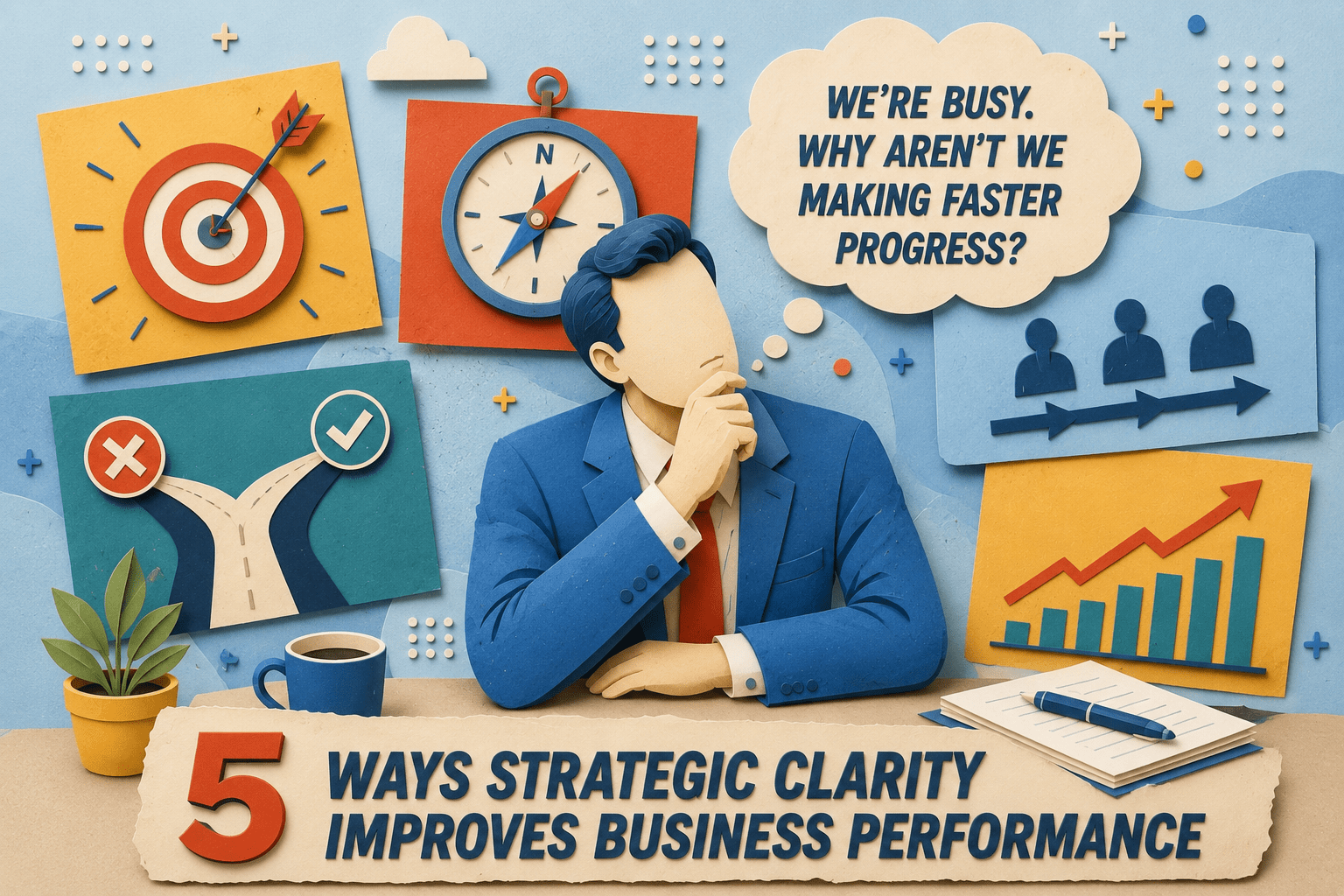
Most business owners assume their biggest challenge is execution.
They need better marketing. More leads. Better systems. Better sales processes. More content. More activity.
Sometimes that’s true.
But after nearly three decades working with founders, leadership teams, and organizations navigating growth, I’ve found that many performance challenges stem from something else entirely.
They stem from a lack of clarity.
As businesses grow, complexity grows with them. Opportunities multiply. Priorities compete for attention. Decisions become more consequential. What once felt obvious becomes harder to navigate. Leaders find themselves working harder, investing more resources, and generating more activity, yet momentum doesn’t always increase proportionately.
The issue is rarely effort.
More often, it’s alignment.
When positioning, messaging, priorities, and business objectives become disconnected, growth becomes harder than it should be. Decisions take longer. Marketing becomes less effective. Teams lose focus. Momentum stalls.
Strategic clarity doesn’t solve every problem, but it makes nearly every problem easier to solve.
1. Creates Focus Amid Too Many Options
One of the most common challenges growing organizations face is not a shortage of opportunities. It’s the opposite.
As a business matures, possibilities begin appearing everywhere. New marketing channels, new partnerships, new technologies, new service offerings, and new investments all compete for attention. Each one may appear valuable in isolation, but organizations only have so much time, energy, and capital to deploy.
Without strategic clarity, everything feels important.
As a result, priorities become blurred. Teams spread themselves too thin. Leaders find themselves reacting instead of directing.
Clarity creates a framework for evaluating opportunities. It helps leaders determine which initiatives deserve investment, which should be delayed, and which should be ignored entirely. Instead of chasing every possibility, organizations can focus their resources on the activities most likely to produce meaningful results.
Focus is not about doing more.
It’s about knowing what matters most.
2. Improves Decisions Under Pressure
As businesses grow, decisions become more consequential.
Questions about hiring, expansion, marketing investments, partnerships, pricing, positioning, and growth strategy carry more weight than they once did. The cost of getting them wrong increases, and uncertainty can make even straightforward decisions feel overwhelming.
When clarity is lacking, leadership teams often revisit the same conversations repeatedly. Discussions become circular. Momentum slows as people struggle to evaluate competing options.
Strategic clarity creates decision-making criteria.
When everyone understands the organization’s priorities, positioning, objectives, and long-term direction, decisions become easier to evaluate. Conversations become more productive because the discussion shifts from personal preference to strategic alignment.
The goal isn’t to eliminate uncertainty.
The goal is to make better decisions with greater confidence.
3. Strengthens Positioning in a Crowded Market
Many businesses eventually outgrow the way they present themselves to the market.
The company evolves. Services evolve. Leadership evolves. The quality of the work improves. Yet the brand continues communicating an older version of the organization.
The result is often frustration.
Prospective clients don’t fully understand the value being offered. Sales conversations require excessive explanation. Marketing efforts generate activity but fail to attract the right opportunities.
Strong positioning helps close that gap.
It provides a clear understanding of who the organization serves, what differentiates it, and why that difference matters. It allows the market’s perception of the business to catch up with the reality of the business itself.
When positioning is clear, everything becomes easier. Marketing gains traction. Sales conversations improve. Referrals become more valuable because people understand how to describe the business to others.
A strong brand isn’t simply more attractive.
It’s easier to understand.
4. Aligns Teams Around What Matters Most
Many growth challenges appear to be operational problems when they’re actually alignment problems.
Marketing may be pursuing one objective while leadership is focused on another. Sales may be communicating a different message than the website. Teams work hard, remain busy, and generate activity, yet progress feels slower than it should.
Misalignment creates friction.
Projects require more meetings. Decisions require more approvals. Communication becomes more complicated. Organizations spend increasing amounts of energy coordinating efforts rather than advancing them.
Strategic clarity creates a shared understanding of priorities, direction, and expectations. It gives teams a common framework for making decisions and evaluating opportunities.
When everyone understands what matters most, collaboration becomes easier and execution becomes more effective.
Alignment reduces complexity.
And reduced complexity creates momentum.
5. Compounds Into Lasting Advantage
Perhaps the most overlooked benefit of strategic clarity is its ability to compound.
A better decision today creates a better outcome tomorrow. Better outcomes create confidence. Confidence improves future decisions. Over time, these advantages accumulate and reinforce one another.
Organizations that appear disciplined from the outside rarely achieve that discipline through a single breakthrough moment. More often, they arrive there through years of making consistently better decisions guided by a clear understanding of their priorities and objectives.
This is why strategic clarity matters so much.
It’s not simply about solving today’s challenges. It’s about creating a framework that improves decisions, alignment, and performance over time.
The benefits may not always be dramatic in the short term.
But they are powerful in the long term.
Clarity Before Activity
Most businesses don’t need more tactics.
They need greater clarity about where they’re going, what matters most, and how decisions should be made along the way.
When positioning, messaging, priorities, and business objectives align, marketing becomes more effective, teams become more focused, and growth becomes easier to sustain.
The work doesn’t necessarily become easier.
The direction becomes clearer.
And clarity creates momentum.
Start With Clarity
If you’re evaluating what’s next for your business, the first step isn’t usually another marketing tactic, website project, or growth initiative.
It’s understanding what’s actually driving the disconnect.
IdeaStorm™ is a focused strategic working session designed to help founders and leadership teams identify challenges, evaluate opportunities, clarify priorities, and determine the highest-leverage next step.
Some clients leave with the clarity they need and implement the recommendations themselves. Others continue into BrandTherapy™, BrandStorm™, or Embedded Advisor engagements.
Either way, the goal is the same: Create clarity before committing additional time, money, or momentum.