Launching a startup brand is exciting. It’s also easy to get wrong.
Every founder has a to-do list. Build the product. Hire the team. Land the first customers. Raise the round. Fix the thing that broke last night. The list never ends, and brand usually sits somewhere near the bottom, squeezed in after everything that feels more urgent.
But here’s the thing about brand: it’s not a task you check off. It’s already happening, whether you’re managing it or not. Every decision you make while you’re heads-down on the to-do list is shaping how people see you. The pricing you set. The way you answer a support email. The tone of your last pitch deck. All of it is brand, whether you called it that or not.
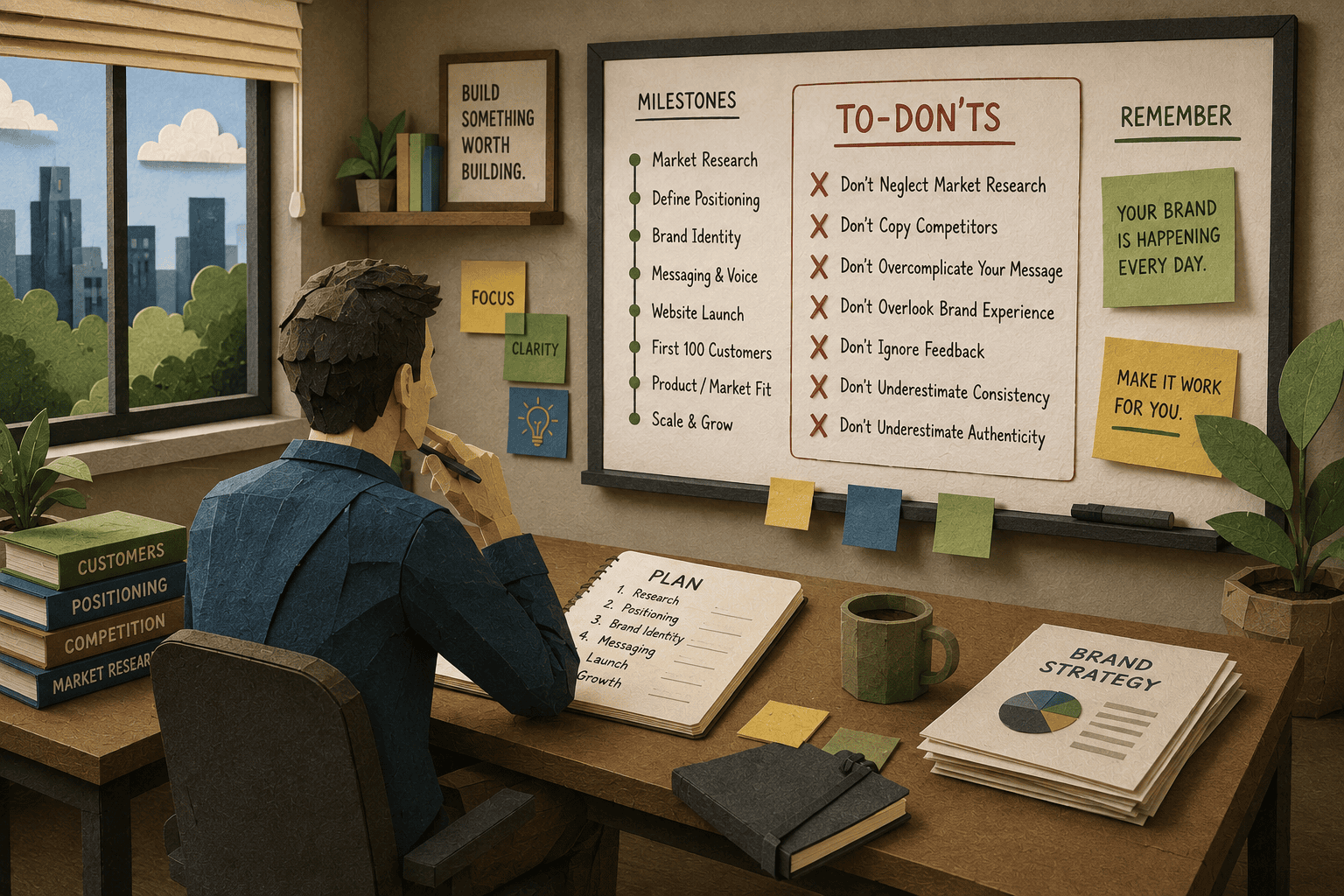
So instead of another to-do list, here’s a to-don’t list. These are the mistakes that undo the good work you’re doing everywhere else. Avoid them, and the brand you’re building without realizing it starts working for you instead of against you.
The Don’t List
Don’t Neglect Market Research
One of the biggest mistakes a startup brand can make is skipping market research. Understanding your audience’s preferences, needs, and pain points is the foundation everything else gets built on. Get to know your customers’ behaviors and motivations before you start making brand decisions. That knowledge is what lets you tailor your messaging and positioning with confidence instead of guessing.
Too many founders build the brand they’d want, not the brand their customer needs. Those aren’t always the same thing. The research is what closes that gap before it becomes expensive to fix.
Don’t Copy Competitors
It’s natural to look at successful brands in your space and want to borrow what’s working. But copying your competitors only gets you one thing: blending in. Differentiate instead. Find what actually sets you apart and say it clearly. Authenticity and originality are what carve out your own space in the market — imitation just makes you forgettable.
Ask yourself what your brand would lose if a competitor’s name were swapped in for yours. If the answer is “nothing,” you don’t have a brand yet. You have a template.
Don’t Overcomplicate Your Message
Simplicity wins. Jargon, complex language, and convoluted explanations confuse your audience before they ever get to know your brand. Say what you do, clearly and directly. Your audience should understand your value without having to work for it — that’s what makes a brand memorable.
Complexity often feels like sophistication when you’re the one writing it. It rarely reads that way to the person hearing it for the first time. If you need a follow-up sentence to explain your first sentence, cut the first one.
Don’t Overlook Brand Experience
Branding is more than visuals. It’s every interaction someone has with you, from browsing your website to getting customer support. Pay attention to the full customer journey and make sure every touchpoint reflects who you actually are. Thoughtful service, packaging, and interactions build the loyalty that logos alone never will.
A polished logo can’t compensate for a clunky checkout process or a support ticket that goes unanswered for a week. Customers don’t experience your brand guidelines. They experience what happens when something goes wrong, and how you handle it.
Don’t Ignore Feedback
Feedback — from customers, employees, or stakeholders — tells you where your brand is actually falling short. Listen to it. Acknowledge it. Use it. The brands that keep improving are the ones willing to hear what isn’t working and act on it.
The founders who struggle with this most are usually the ones closest to the product. Distance makes feedback easier to dismiss. Proximity makes it easier to take personally. Neither reaction gets you closer to fixing the actual problem.
Don’t Underestimate Consistency
Consistency builds familiarity, and familiarity builds trust. That doesn’t mean your brand can never evolve — it means changes should be deliberate, not abrupt. Sudden shifts in your visual identity, messaging, or values confuse your audience and erode the equity you’ve worked to build. A consistent experience across every touchpoint is what reinforces your brand and keeps customers coming back.
Inconsistency doesn’t usually show up as one big mistake. It shows up as a dozen small ones: a different tone in every email, a website that doesn’t match the pitch deck, a promise on social media that support can’t keep. Each one on its own seems minor. Together, they tell your customer you don’t know who you are.
Don’t Underestimate Authenticity
Authenticity is what separates the brands people remember from the ones they forget. Be honest and transparent in how you communicate. Don’t build a facade that doesn’t match what your startup actually delivers — customers can tell the difference, and they’re drawn to brands that stay true to their word.
This matters more in a startup than almost anywhere else. You don’t have decades of track record to fall back on. Your word is often the only proof point you have. Break it once, publicly, and you spend the next year trying to earn back what took one moment to lose.
Branding Is Never Finished
Building a brand takes time, patience, and a real understanding of who you’re building it for. There’s no launch date where the work is done and you move on to the next thing. The brand you built at the six-month mark is not the brand you’ll need at eighteen months, and that’s not a failure. That’s just what growth does.
The market shifts. Customer expectations shift. Your own business shifts faster than you’d expect, especially in the early years, and your brand has to keep pace or it starts working against you instead of for you. A brand that doesn’t evolve becomes a liability. It starts making promises your business has already outgrown, or speaking to a customer you no longer serve.
Staying attuned to those changes and adjusting your strategy accordingly is what keeps a brand relevant instead of dated. That doesn’t mean chasing every trend or reacting to every piece of feedback. It means checking in on your brand the same way you’d check in on your finances or your product roadmap: regularly, honestly, and before a small gap becomes a real problem.
Stay committed to what your brand stands for. Keep adapting to your audience’s changing needs. Treat the don’t list as seriously as you treat the to-do list, and the results will follow.
Building a brand takes time, patience, and a real understanding of who you’re building it for. But it doesn’t stop once you’ve got the fundamentals in place. The market shifts. Customer expectations shift. Staying attuned to those changes and adjusting your strategy accordingly is what keeps a brand relevant instead of dated.
Stay committed to what your brand stands for, keep adapting to your audience’s changing needs, and the results will follow.