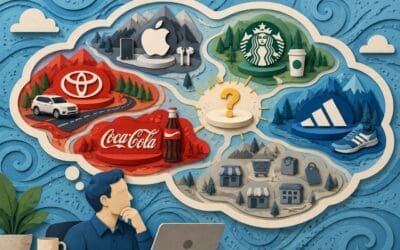
Everybody wants a brand that’s different. Ask a room of founders and nearly all of them will say so, and nearly all of them will then describe a company that looks, sounds, and behaves like the rest of their industry.
That’s the paradox. Most organizations say they want to be distinctive while wanting to conform. Conforming feels safe. Nobody gets fired for looking like the category leader.
I started to write this as “50 Ways to Differentiate Your Brand,” but it quickly became a catalog of tactics: slow down, tell a story, change the name, put a famous face on it. But a list of fifty options gives a leader fifty ways to avoid choosing one. So I started over and instead began with a single question, the one I ask nearly every client in positioning workshops: What makes you different?
Different is not the same as distinctive
These two words get used interchangeably, and they shouldn’t be.
Distinctive means recognizable. It’s the color, the typeface, the sound, the tone of voice. It makes you easy to remember and easy to find.
Different means meaningfully unlike your alternatives in a way customers care about. It’s a reason to choose you.
Distinctiveness without difference is a costume. Plenty of brands look unmistakable and offer nothing a competitor doesn’t. Difference without distinctiveness is the opposite problem: a real advantage nobody notices. You need both, but difference comes first, because it’s the harder one to fake.
The strongest brands manage both. Apple always looks like Apple, and Tiffany owns a shade of blue so completely that a robin’s-egg box can carry the brand before anyone reads the name. But that recognizability was earned. Apple’s look is the visible edge of a different way of designing products, and Tiffany’s box works because of what people believe is inside it. The look is how people spot the difference.
Start one degree away
Founders often think differentiation requires a big leap: a new category, a breakthrough, a shocking campaign. Occasionally it does. Far more often it starts with a premise just one degree away from your rivals, then holds that premise with discipline for years.
Consider Liquid Death. Bottled water is about as undifferentiated as a product gets. The brand didn’t change the water. It changed the frame by putting it in a tallboy can and giving it the attitude of a heavy metal band instead of a spa: same product, different premise. The idea is simple, and it has been held consistently enough that nobody confuses it with a competitor.
The premise can be small. What matters is that it’s true, that it’s yours, and that you keep going in the same direction long enough for it to compound.
Four places real difference comes from
In my experience, durable differentiation comes from one of four places. Most strong brands are built on a single one, not all four.
1. What you believe.
Patagonia ran an ad in 2011 telling people not to buy its jacket. In 2022, founder Yvon Chouinard transferred ownership of the company to a trust and a nonprofit so its profits would fund climate-change efforts. Whatever you think of the politics, the brand is believable because the beliefs show up in decisions that cost something. Values only differentiate when they’re expensive.
2. How you do it.
Go slow in a world of speed. Each Rolex takes about a year (sometimes more) to make, and that long process reinforces the perception that this is the world’s best timepiece. Zappos built its advantage on free returns and service that went above and beyond, which dissolved the main objection to buying shoes online. Trader Joe’s did it with a small store, a few thousand carefully chosen products, and a private-label model that turns shopping into discovery. In each case, the difference is operational. A competitor can copy the ad, but not the way the company runs.
3. Who you serve.
Sometimes the opening is an audience everyone else overlooked. Enterprise Rent-A-Car built its business around people whose cars were in the shop, a customer the airport-counter competitors weren’t chasing, and paired that with a “we’ll pick you up” service. Drawing in an untapped audience and serving it well intensifies the sense of community around a brand. It also means being willing to narrow. I once heard a business owner object to this idea, fearing they would be pigeonholed into too small a niche. Someone once told me, “Pigeonholes are where the money is; you just need to reach down into them. The riches are in the niches.”
4. Where you come from.
Some brands differentiate through a story only they can tell. There are several kinds:
- The underdog. Underdogs win the compassionate consumer. Nantucket Nectars started as a small floating business selling fresh juice drinks to yachts out of a boat in Nantucket Harbor, Massachusetts. Look for the underdog story you can tell.
- The founder. Chanel still personifies the philosophies, ideals, and legend of Coco Chanel long after her death. Kentucky Fried Chicken keeps the Colonel and his secret recipe front and center. Virgin is inseparable from Richard Branson. The task is to forge new ground in the founder’s spirit, not to preserve a museum.
- The heritage. Hickory Farms leans on its origins.
- The imagination. Elves make Keebler cookies in a hollow tree.
- The secret. Coca-Cola has spent more than a century guarding its formula, and the legend that almost no one knows it is part of the product.
When one degree isn’t enough
Sometimes the best move really is a leap. The Toyota Prius, the Nintendo Wii, and Red Bull each stepped outside the established norms of their product category and created a space they could call their own. Tesla did something even bigger. It didn’t just sell a different car. It changed what people expect a car to be, and how they think about driving.
Change the possibilities. This is about more than product innovation. It’s about introducing something that changes how people live. It’s also the riskiest path on this page, and it only works for brands willing to be misunderstood for a while.
Difference has a price
This is the part most brands skip. Real differentiation means saying no, and saying no costs money.
Chick-fil-A closes every Sunday, giving up a full day of sales every week, in an industry where weekends are prime. That choice is inconvenient for some customers, and it’s also the most recognizable fact about the company. The sacrifice is what makes the belief credible.
If your point of difference never costs you anything, it probably isn’t one. Ask what you would have to refuse, abandon, or stop doing to make it real. If the answer is “nothing,” you’ve written a tagline, not a strategy.
Five questions to find your answer
When I work with business owners on this, we start here:
- What do you do that competitors can’t or won’t? Think of the thing that’s hard to copy, not the thing that’s easy to say.
- What do customers say you’re known for, in their words, not yours?
- Who would miss you? If you vanished tomorrow, which customers would be genuinely upset, and why them?
- What would you refuse to do? What’s the cost of your point of view?
- Can you hold it for ten years? Differentiation is a long game. If you’d drop it in a bad quarter, it isn’t a foundation.
The discipline is the strategy
This is just a snapshot of the many strategies that brands can adopt to forge a distinctive path in the marketplace. With each strategy, brands can carve out a unique space for themselves, leveraging everything from their origins and customer experiences to their visual identity and narrative.
The brands above all share one habit: each move builds on the last. Build groundswell. Do something startling to generate attention. Use attention to build a crowd. Use a crowd to gain credibility. Use credibility as the jumping-off point for your next distinctive act. That’s how one degree of separation becomes a lasting advantage.
Most of the businesses I’ve worked with didn’t lack ideas about how to be different. They lacked the discipline to choose one and stick with it. Differentiation isn’t a campaign. It’s a decision that has to be made again and again, in hiring, in pricing, in what you build and what you decline. To truly differentiate, a brand must not only aspire to be different but must also embrace and cultivate these differences in every aspect of its operation and presentation.
So, back to the question: What makes you different? If the answer takes more than a sentence, or sounds like something your competitors could say, that’s your starting point.