In 1998, I had what most people would have considered a pretty good job. I had been working at the National Football League for almost a year, helping develop strategy and design for the league’s retail and licensing programs. Before that, I had worked for Gap and Banana Republic, so the combination of branding, retail, merchandising, and design felt like a natural fit. I was learning a tremendous amount, working alongside talented people, and building experience that would prove valuable throughout my career.
But like a lot of designers, I also took on some freelance work on the side.
A Freelance Relationship That Outgrew Its Boundaries
One of my clients was a software startup whose product really interested me. Their software tackled a tricky tax and reporting issue, and I spent months helping them build a visual identity and design ideas that made their technology easier to grasp.
Things were going great with them. One day, the founders called me with an offer. They liked my work and wanted to give me a lot more projects. But they also knew I had a full-time job. They didn’t just need occasional freelance help anymore; their business was growing fast, and they needed someone who could keep up.
They were very straightforward. They said they would either send all the work to me or none at all. They knew I had other commitments, but they needed to know if I was ready to take the leap.
After looking at the amount of work and the fees, I realized they were right. There was no way I could keep my full-time job at the NFL and handle all the projects they wanted me to take on.
A Terrifying Decision at Twenty-Eight
For the first time, I had a real entrepreneurial choice to make. I could stick with my steady job and give up a growing side business, or I could leave the NFL and try to build something myself. At twenty-eight, that was a scary decision.
Technically, I had been self-employed before. After college, I freelanced for a few agencies. But thinking back, that wasn’t true entrepreneurship. I still went to someone else’s office every day and worked on their problems. The only difference was that I sent invoices instead of getting a paycheck.
This time felt completely different. I would have to find clients, manage projects, set my own fees, collect payments, pay taxes, and figure out how to actually run a business. The problem was, no one had ever taught me any of that. Design school taught me about typography, color, layout, and idea generation. It didn’t teach me how to run a company.
So I called the only person I knew who had already done what I was thinking about.
Lunch in Jersey City
My cousin, Steve Wagner, was a lawyer who built his own law practice, which eventually had offices on Park Avenue. To me, he was the closest thing I had to a successful role model in entrepreneurship.
We met for lunch one Sunday at a Cuban diner in Jersey City. I thought it would be a quick chat, but it turned into a long talk about business, risk, and independence. I told him about my situation and asked for his advice, and he shared how he got started.
When he started his law practice, he was thirty-one, just married, had a baby at home, and no clients at all. As he told me about his situation, my own decision didn’t seem so dramatic. I wasn’t married, didn’t have kids, and already had a client who wanted to give me more work. Compared to what he faced, my leap didn’t seem so big.
By the end of lunch, I knew what I was going to do. Before we left, though, Steve gave me one last piece of advice that has stuck with me for almost thirty years.
The Sinkhole
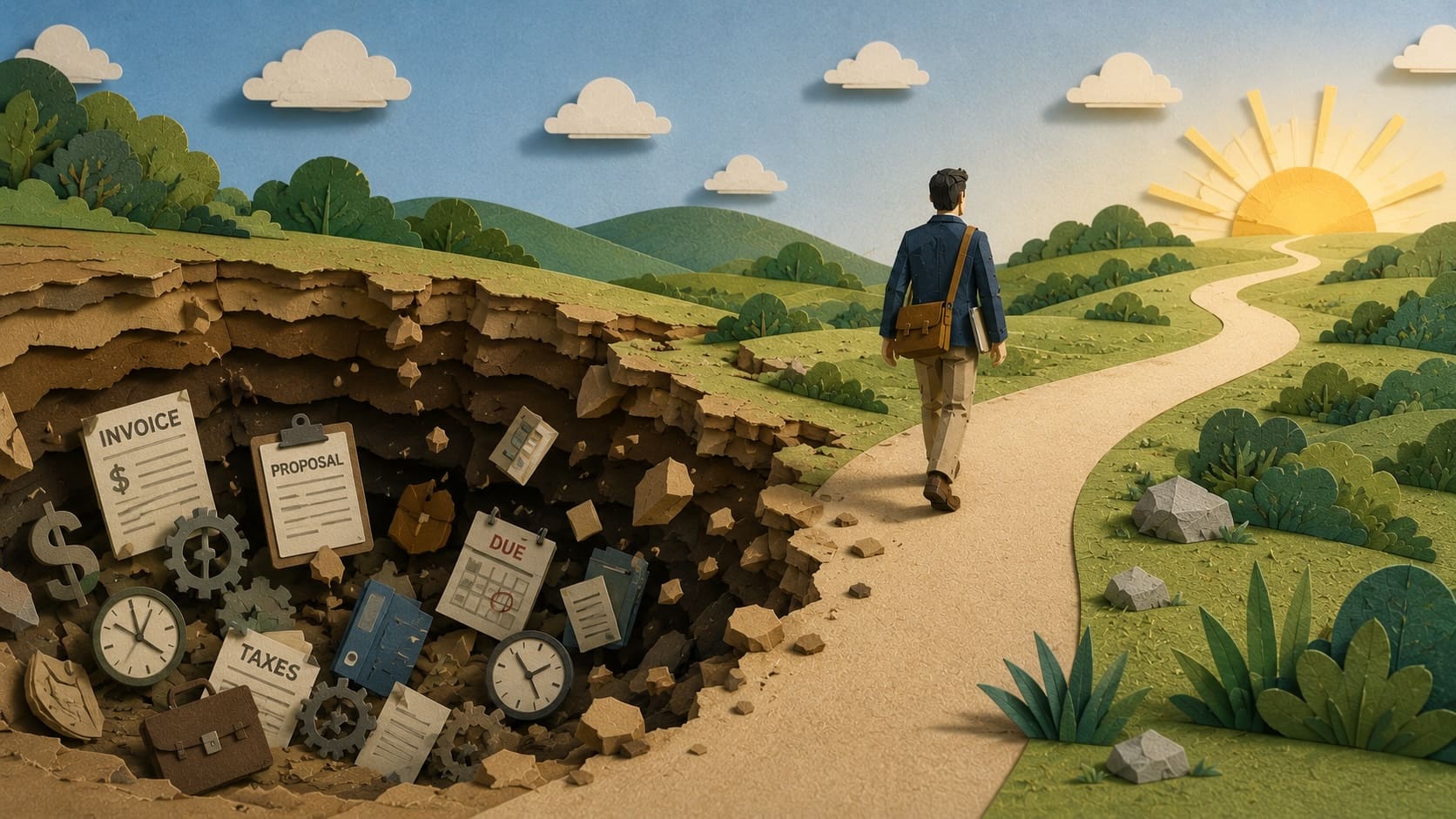
He told me that owning your own business can be very rewarding. It gives you freedom, flexibility, and chances you might never get working for someone else. Then he paused and said it also felt like there was a giant sinkhole right behind you.
He explained that the sinkhole keeps getting bigger. No matter how fast you move, it keeps growing. Every day, you’re moving forward and trying not to get caught by it.
At the time, I laughed because it sounded dramatic. Years later, I understood what he meant. The sinkhole is every proposal you still need to write, every client you still need to win, every unpaid invoice. It’s every tough conversation, every uncertain choice, and every month when you wonder where the next job will come from. It’s a constant reminder that you’re the only one responsible for moving the business forward.
Now, twenty-seven years later, I know exactly what he meant.
When the Sinkhole Started Winning
That first business didn’t last. The dot-com bubble burst, and then September 11 happened. Some clients disappeared almost overnight. Others slowly cut their budgets or closed down over the next few years. For a long time, I felt like I was using all my energy just to keep up.
To find more stability, I started teaching at a university. What began as a practical choice turned into one of the most meaningful parts of my career and lasted over twenty years. Later, I went back to the corporate world.
From the outside, it probably seemed like the smart move. But something always felt unfinished. No matter how much I liked the work, I kept feeling like I didn’t really belong. I missed building something of my own. I missed being my own boss, making the decisions, taking the consequences, and knowing that every win or loss was mine.
Most of all, I missed the sense of possibilities.
Stepping Back Out
So in 2015, I went out on my own again. This time, I had more experience, more perspective, and a much better idea of what entrepreneurship really takes.
What I didn’t expect was how often I’d think back to that lunch in Jersey City with Steve. Even now, more than ten years into this chapter and almost thirty years since that conversation, I still remember his sinkhole metaphor. He was right.
Self-employment has given me freedom, flexibility, great relationships, meaningful work, and chances I never could have imagined. It’s also brought uncertainty, setbacks, stress, and plenty of sleepless nights.
What I Understand Now
The sinkhole never disappears. There’s always another proposal to write, another client to find, another problem to solve, another bill to pay. Some months, you’re ahead of it. Other months, you feel it catching up.
But if you’re built for this life, something changes. After a while, you stop worrying about the sinkhole and start focusing on where you’re headed. The uncertainty and risk never go away, but neither does the satisfaction of building something that’s yours.
Looking back, Steve wasn’t trying to scare me away from entrepreneurship. He was getting me ready for it. He wanted me to see that uncertainty isn’t something you outgrow; it’s part of the job. If you can accept that, self-employment can be one of the most rewarding journeys there is. The lesson is to accept uncertainty as the price of freedom.
Almost twenty-seven years later, the sinkhole is still there. But so am I, and that’s what matters.
And if I had to do it all again, I’d still leave the NFL.